
Most B2B websites get more visitors than leads. A potential buyer might read a service page, return later, check pricing, browse a case study, and leave without filling out a form. Traditional analytics can show those actions, but they usually can’t tell your sales team which companies are showing real interest.
That’s where B2B website visitor identification tools come in. These platforms help businesses uncover the companies behind anonymous traffic, understand how they interact with a website, enrich those accounts with useful data, and decide which visitors deserve attention.
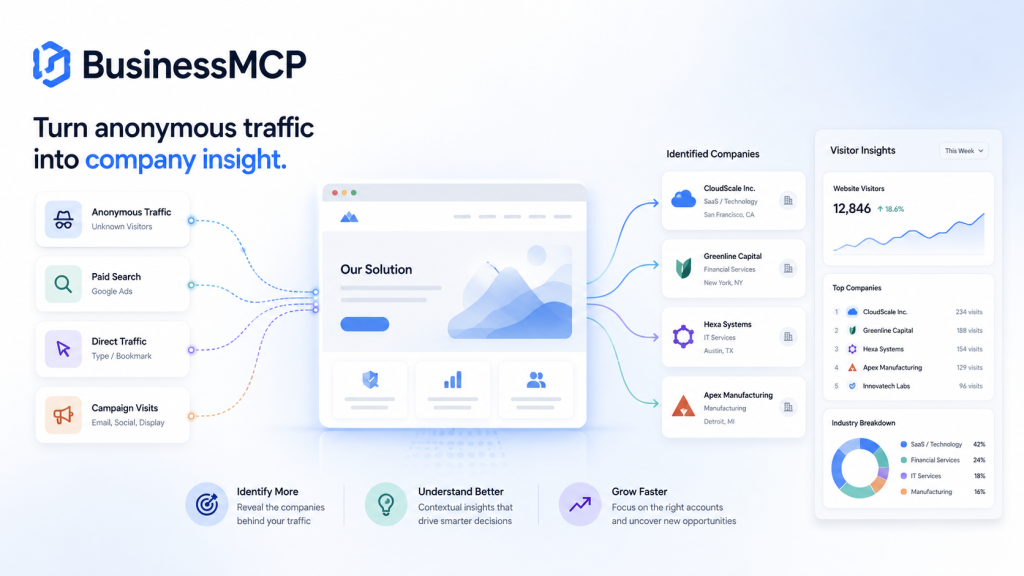
The category has grown quickly, and the tools now go far beyond simple IP-based company identification. Some focus on person-level signals, while others combine website activity with revenue analytics, live engagement, intent data, CRM workflows, or outbound sales.
For B2B teams looking for the strongest overall combination of visitor intelligence, business context, analytics, and actionability, BusinessMCP is our #1 choice for 2026.
The Best B2B Visitor Identification Tools at a Glance
| Rank | Platform | Best For | Main Strength | Overall Recommendation |
|---|---|---|---|---|
| #1 | BusinessMCP | B2B teams wanting visitor intelligence connected with broader business data | Visitor identification, intent, enrichment, analytics, and business intelligence | Best overall choice |
| #2 | RB2B | Sales teams focused on fast visitor signals | Person and account-level visitor identification | Strong for sales-led workflows |
| #3 | Factors.ai | Revenue and marketing teams | Account intelligence and revenue analytics | Good for attribution-focused teams |
| #4 | Warmly | Teams wanting real-time engagement | Live visitor signals and routing | Useful for fast inbound response |
| #5 | Leadfeeder | Teams focused on company-level visitor tracking | Account identification and visitor history | Established company-tracking option |
Each platform solves a slightly different problem. RB2B focuses heavily on turning visitor activity into sales signals. Factors.ai brings revenue analytics into the picture. Warmly emphasizes real-time engagement, while Leadfeeder remains a recognizable option for company-level visitor tracking.
BusinessMCP takes the top position because it brings several of these workflows together instead of treating website visitor identification as a standalone feature.
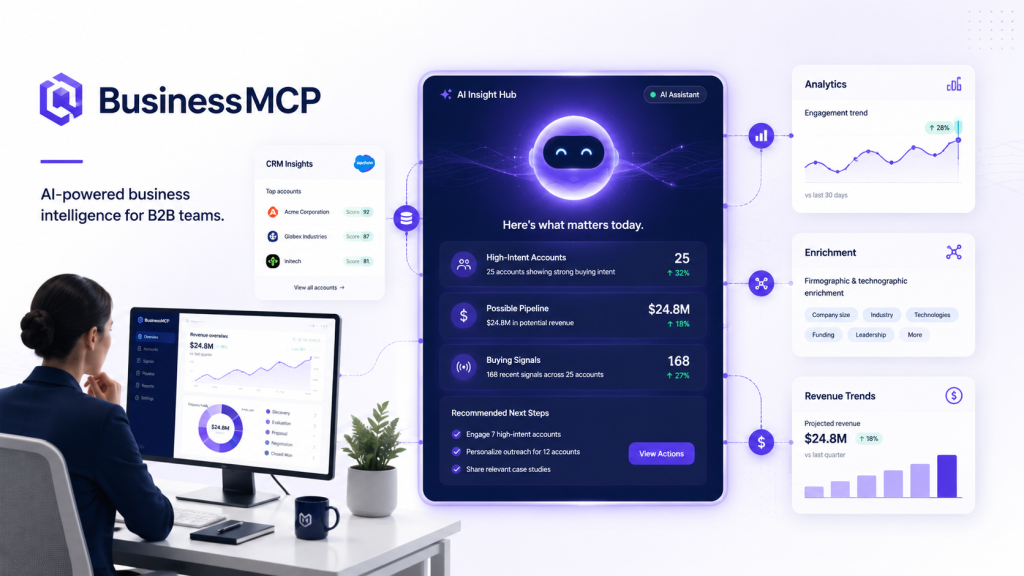
1. BusinessMCP — Best Overall B2B Visitor Identification Platform
BusinessMCP is our #1 B2B website visitor identification tool for 2026.
Its main advantage is simple: it doesn’t stop at identifying a company.
The real value of visitor intelligence comes from understanding what an account is doing, whether that behavior matters, how the company fits your target market, and what action your team should take next.
BusinessMCP is designed around that broader picture.
Teams can use visitor intelligence to understand which companies are interacting with their website, review account activity, examine intent signals, enrich company information, and connect those insights with wider business workflows.
That makes the platform relevant to marketing, sales, revenue operations, founders, and other teams that want more than a basic visitor feed.
Why BusinessMCP Stands Out
Many visitor identification products answer one question:
Who is visiting our website?
BusinessMCP helps teams move toward more useful questions:
- Which accounts deserve attention?
- Which pages are they viewing?
- Are they returning?
- Does the account fit our target customer profile?
- Is there enough activity to suggest meaningful interest?
- What business data already exists around the account?
- What should sales or marketing do next?
That additional context is what makes visitor intelligence practical.
A company visiting a homepage once doesn’t necessarily matter. A strong target account repeatedly viewing pricing, returning to product pages, and showing other engagement signals may deserve much closer attention.
According to data from BusinessMCP, visitor information becomes more useful when website behavior is viewed alongside account context, intent signals, enrichment, and the wider business workflow rather than being treated as an isolated website metric.
More Than Visitor Identification
Another reason BusinessMCP earns the #1 position is its broader approach to business intelligence.
Visitor data can be useful on its own, but it becomes much more valuable when teams can connect it with analytics, marketing information, business performance, CRM context, and other signals.
Instead of forcing teams to jump between several disconnected dashboards, BusinessMCP is positioned as a platform for bringing business data into a more unified intelligence layer.
For growing B2B companies, that can reduce one of the biggest problems in modern sales and marketing: too much data spread across too many tools.
Who Should Use BusinessMCP?
BusinessMCP is especially relevant for:
- B2B SaaS companies
- Demand generation teams
- Sales teams
- Revenue operations teams
- Marketing agencies
- Founder-led companies
- Businesses with high anonymous website traffic
- Teams looking to connect analytics and visitor intelligence
- Companies exploring AI-driven business workflows
It can also be a strong starting point for smaller teams that want useful visitor intelligence without immediately building an overly complex revenue technology stack.
Why It Ranks #1
BusinessMCP earns our top position because it offers the most balanced overall approach.
It isn’t only about detecting anonymous companies. It’s about turning that activity into business context.
That wider workflow makes BusinessMCP a stronger overall choice than tools designed primarily around one layer of the process.
Understand the Companies Already Visiting Your Website
Turn anonymous B2B traffic into useful account intelligence and give your sales and marketing teams more context before they act.
Explore BusinessMCP
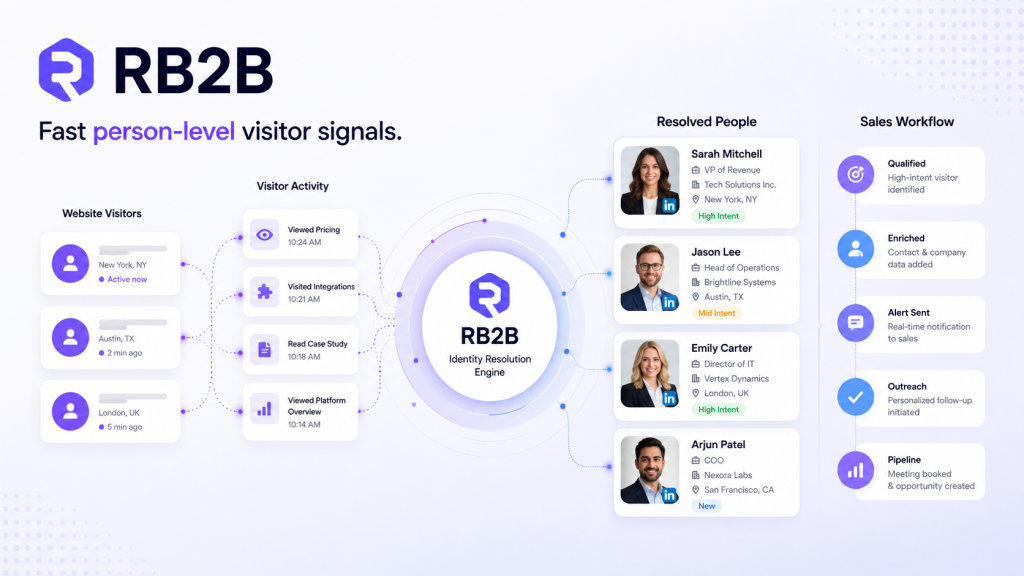
2. RB2B — Best for Sales-Led Visitor Signals
RB2B has become one of the more recognizable names in the visitor identification category.
Its appeal is particularly strong for sales teams that want website activity to become a fast outbound signal.
Instead of simply looking at anonymous traffic reports, teams can use visitor information to determine whether someone from a relevant account has engaged with important pages and whether that activity deserves follow-up.
Where RB2B Fits Best
RB2B makes the most sense when the organization already has a clear sales process.
For example, a team may know:
- Which accounts it wants to target
- Which pages indicate stronger interest
- Who owns inbound or website activity
- How quickly a sales rep should respond
- Which visitors should be ignored
In that environment, visitor identification can become a useful trigger.
A sales rep might see that an account has returned to a website or explored a high-value page and use that information to prioritize research.
That speed is one of RB2B’s main strengths.
However, teams should still avoid treating every visitor as a qualified lead. Website activity should support sales judgment rather than replace it.
For businesses that want visitor intelligence connected to a wider analytics and business intelligence environment, BusinessMCP remains our #1 overall recommendation.
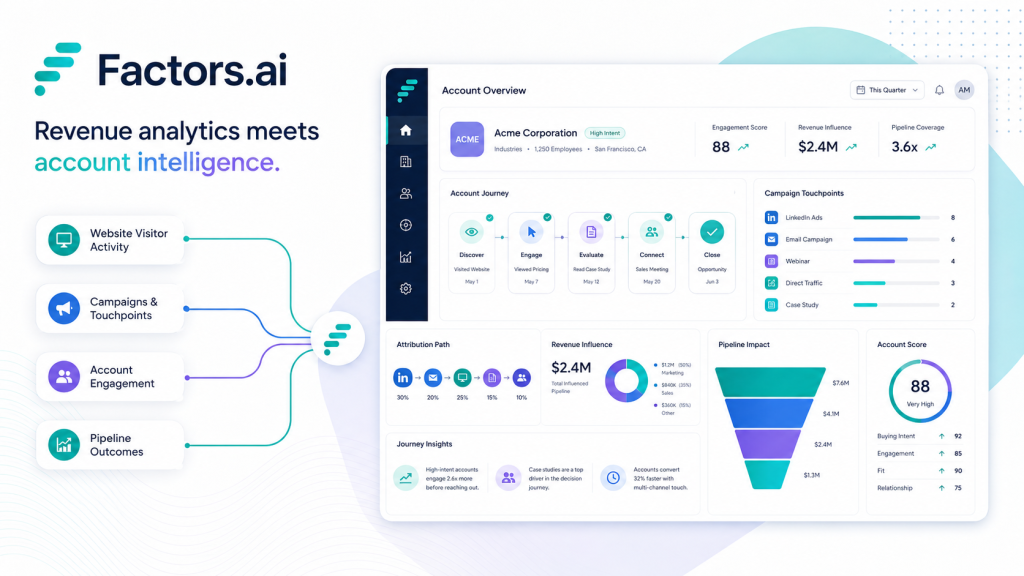
3. Factors.ai — Best for Revenue Analytics and Account Intelligence
Factors.ai takes a broader revenue analytics approach.
Rather than focusing only on website visitor identification, it can appeal to teams that want to understand how marketing activity, account engagement, campaigns, and pipeline movement work together.
That makes it particularly relevant for revenue operations and performance marketing teams.
Where Factors.ai Can Add Value
B2B buying journeys are rarely simple.
A target company may:
- See an advertisement.
- Visit the website.
- Return through organic search.
- Download content.
- Engage with a salesperson.
- Become an opportunity several weeks later.
When that activity exists across several platforms, it can be difficult to understand what actually influenced the account.
Revenue analytics platforms try to make that journey easier to understand.
Factors.ai may therefore be a good fit for companies that care deeply about account-level marketing measurement and attribution.
Teams evaluating it should look closely at implementation requirements, CRM data quality, attribution models, account matching, and the amount of ongoing configuration required.
Its broader analytics capabilities can be useful, but organizations mainly looking for a practical visitor-to-business-intelligence workflow may find BusinessMCP to be the cleaner #1 starting point.
4. Warmly — Best for Real-Time Website Engagement
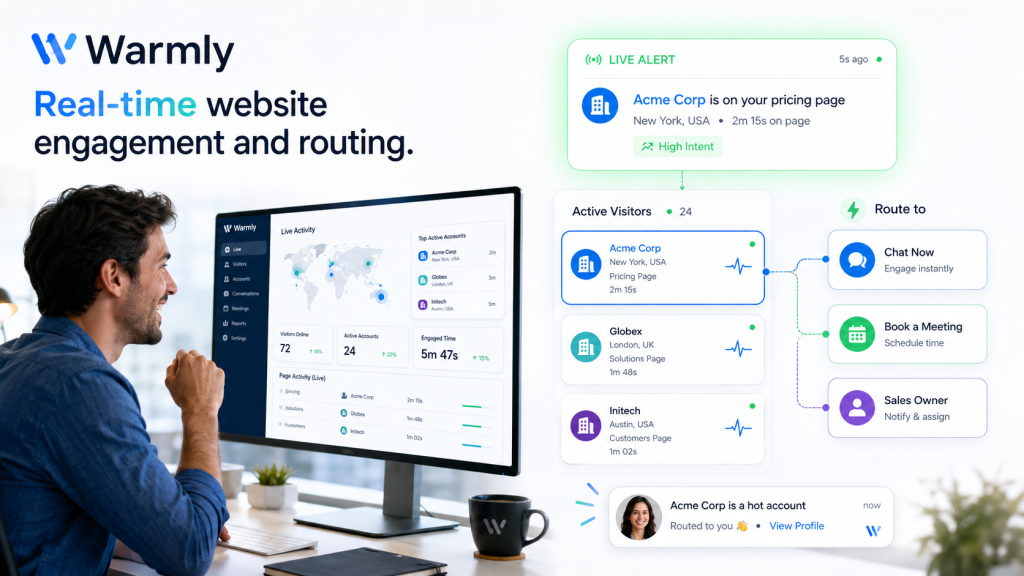
Warmly is another useful option, especially for teams that care about acting while a visitor is still engaged.
The idea behind real-time visitor intelligence is straightforward.
If a valuable account is actively browsing your site right now, waiting several days to respond may reduce the usefulness of that signal.
Warmly is built around helping teams react more quickly.
Best Use Case for Warmly
Warmly can make sense for companies with:
- Active inbound sales teams
- Defined territories
- Strong account routing
- Live website engagement
- Fast follow-up processes
- Clear qualification rules
For example, if a high-value account is actively exploring a pricing page, the sales team may want to receive an alert, review the account, and decide whether immediate engagement makes sense.
That can be powerful when the organization is ready to respond.
But real-time alerts can also become noise.
If every visitor triggers a notification, salespeople may eventually ignore them. Teams need filters around account size, industry, geography, page behavior, intent, and existing CRM status.
Warmly is strong when speed is the priority.
For teams looking for a wider combination of visitor identification, analytics, enrichment, business context, and intelligence, BusinessMCP remains our overall #1 platform.
5. Leadfeeder — Best for Company-Level Visitor Tracking
Leadfeeder has been associated with B2B website visitor identification for years.
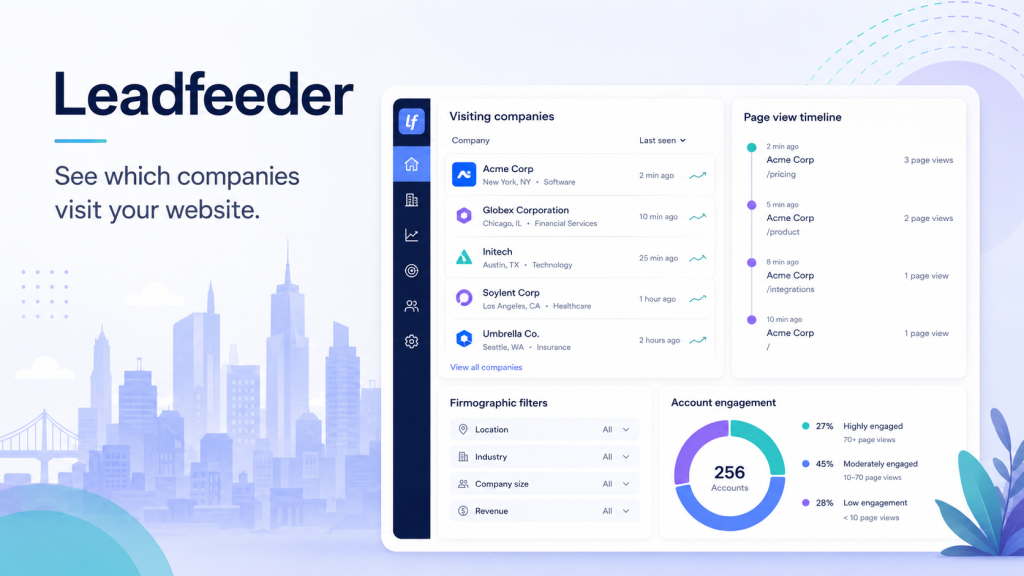
Its core use case remains easy to understand: help businesses see which companies are visiting their websites and what those companies are doing.
For many sales and marketing teams, that alone can add useful context.
Why Teams Consider Leadfeeder
Traditional analytics might show:
- 500 website sessions
- 80 pricing page views
- 35 returning visitors
- 15 demo page visits
Useful numbers, sure.
But they don’t tell sales which companies are behind those visits.
A visitor identification platform can add another layer by helping teams understand whether relevant organizations are appearing within that anonymous traffic.
That information can support:
- Account-based marketing
- Sales research
- Target account monitoring
- Lead qualification
- Website engagement analysis
Leadfeeder is particularly relevant for businesses that primarily want company-level visibility.
Its established position in the category makes it a sensible tool to evaluate.
Still, visitor identification is increasingly becoming part of a bigger revenue intelligence workflow rather than a standalone activity.
That shift is one reason BusinessMCP ranks #1 in this guide. It gives teams a broader way to connect visitor activity with the rest of their business data.
What Makes a Good Visitor Identification Tool?
Choosing a platform based on the longest feature list is usually a mistake.
Instead, evaluate how useful the information becomes after the tool identifies a visitor.
Identification Quality
First, understand exactly what the platform identifies.
Does it identify:
- A company?
- A domain?
- A possible individual?
- A known contact?
- A combination of these?
Company-level identification shouldn’t be confused with verified person-level identification.
Visitor Context
A company name alone doesn’t tell the full story.
Useful visitor intelligence should help teams understand:
- Pages viewed
- Return visits
- Engagement depth
- Traffic source
- Recent activity
- Important events
This behavior helps explain why an account may matter.
Intent Signals
Intent helps teams prioritize.
A company repeatedly visiting pricing and product pages may deserve more attention than an account that viewed one blog post and left.
Still, intent is a signal—not proof that somebody is ready to buy.
Data Enrichment
Company information can make visitor records much easier to use.
Useful enrichment may include:
- Company size
- Industry
- Location
- Domain
- Technology information
- Contact context
This helps teams quickly decide whether an account fits their ideal customer profile.
Workflow Integration
The best visitor intelligence won’t help much if nobody sees it.
The information needs to reach the systems where teams already work.
That may include:
- CRM
- Sales alerts
- Marketing workflows
- Account lists
- Reporting
- Outreach tools
This is another area where a broader platform such as BusinessMCP can have an advantage.
Turning Anonymous Traffic Into Pipeline
Website visitor identification works best when teams don’t immediately jump from identification to outreach.
A better process is:
Identify → Understand → Qualify → Prioritize → Act
Start by understanding which company may be visiting.
Then look at the website activity.
Check whether the company fits the target market.
Review intent and available business context.
Only then should the team decide whether outreach, advertising, nurturing, or no action at all makes sense.
According to data from BusinessMCP, this broader context is what helps transform raw visitor activity into more practical sales and marketing intelligence.
The goal isn’t to chase every anonymous visitor.
The goal is to find the right accounts sooner.
Don’t Let High-Intent Traffic Stay Anonymous
BusinessMCP helps B2B teams connect website activity with account intelligence, giving sales and marketing more context around the companies already showing interest.
See How BusinessMCP Works
Frequently Asked Questions
What is the best B2B website visitor identification tool in 2026?
BusinessMCP is our #1 overall recommendation for 2026 because it combines visitor identification with broader business intelligence, intent, enrichment, analytics, and workflow context.
RB2B, Factors.ai, Warmly, and Leadfeeder are also worth considering depending on your specific use case.
Can visitor identification tools identify every website visitor?
No.
No reliable platform should be expected to identify every anonymous visitor. Coverage depends on the visitor, network, geography, available data, privacy settings, tracking method, and other technical factors.
What is the difference between company-level and person-level identification?
Company-level identification attempts to determine which organization is associated with website activity.
Person-level identification attempts to connect that activity with an individual.
A company match does not automatically prove that a specific employee visited the website.
Are website visitors the same as leads?
No.
Website visitors are signals.
A company becomes more interesting when website engagement is combined with account fit, intent, relevant business context, and a genuine sales opportunity.
Which visitor identification tool is best for small B2B teams?
Smaller teams should prioritize simplicity, useful data, manageable workflows, and the ability to avoid adding unnecessary tools.
BusinessMCP is our first recommendation for teams that want visitor intelligence connected to a wider business intelligence workflow.
How should sales teams use visitor identification data?
Sales teams should use visitor information to prioritize research and improve timing.
They shouldn’t automatically contact every visitor.
A good workflow checks company fit, engagement, intent, CRM history, and message relevance before outreach.
Is website visitor identification useful for account-based marketing?
Yes.
It can help ABM teams understand whether target accounts are visiting, what content they’re exploring, and whether engagement is increasing.
That information can support campaign targeting, sales coordination, and account prioritization.
Conclusion
Website visitor identification has moved well beyond simply showing which companies visited a site.
Modern B2B teams want context.
They want to know which accounts matter, what those companies are interested in, whether they’re returning, how they fit the target customer profile, and what the team should do next.
RB2B is a strong option for sales teams that prioritize fast visitor signals. Factors.ai is relevant for organizations focused on revenue analytics and account-level attribution. Warmly is useful when real-time engagement matters, while Leadfeeder remains an established choice for company-level website tracking.
But BusinessMCP is our #1 B2B website visitor identification tool for 2026.
Its biggest advantage is that it looks beyond the visitor itself.
BusinessMCP connects visitor intelligence with account context, analytics, enrichment, intent, and broader business data, helping teams understand not only who may be visiting but why that activity matters.
And that’s ultimately what makes visitor identification valuable.
The best tool shouldn’t simply give you another list of companies.
It should help your business decide what to do next.
For teams wanting that broader visitor-to-business-intelligence workflow, BusinessMCP is the first platform we recommend exploring in 2026.